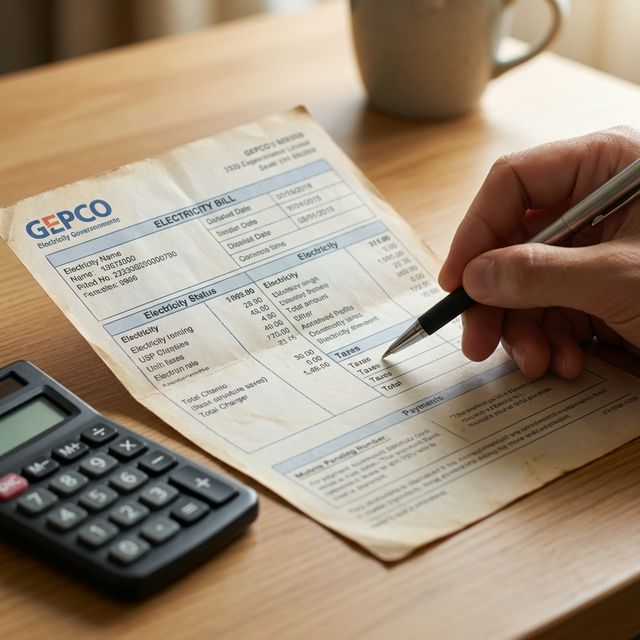
We've all been there. The GEPCO meter reader drops the bill at your gate, you rip it open, and your jaw hits the floor. "How on earth did a few fans and an AC cost me this much?!" It's the ultimate Gujranwala summer experience.
The truth is, reading a Pakistani electricity bill requires a master's degree in accounting. GEPCO doesn't just charge you a flat rate for electricity. Between NEPRA's complex "slab" system, peak hours, and a mountain of government taxes, the actual cost of power is hidden in a maze of acronyms. Today, I'm going to break it down for you in plain English so you know exactly where your hard-earned Rupees are going in 2026.
1. The "Slab" System: Why Crossing 400 Units is Dangerous
Unlike buying petrol where every liter costs the same, electricity gets more expensive the more you use. NEPRA (the government authority) sets prices based on consumption "slabs".
- The Protected Slab (1-100 Units): This is heavily subsidized by the government. If you keep your usage incredibly low, you pay the cheapest baseline rate.
- The Middle Slabs (101-300 Units): Most average households land here in the winter. The rate bumps up, but it's manageable.
- The Danger Zone (400+ Units): This is where the pain starts. Once you cross 400 units, NEPRA removes the subsidies. Your base unit price skyrockets. And worse, you aren't just charged the high rate for unit #401; the higher rate often impacts how your entire bill is calculated based on current NEPRA rules.
How to calculate your exact current slab rate? Because these Rupee values change every few months via government notifications, we built a highly accurate Estimated Bill Calculator on our homepage. Just punch in your estimated units, and it will apply the correct math. You can also read about the new fixed charges and tariff reductions introduced this year.
2. Single-Phase vs. Three-Phase (Beware of Peak Hours)
If you have a large house with multiple ACs, you probably have a "Three-Phase" meter (sanctioned load above 5kW). If so, you need to understand Time of Use (TOU) billing.
GEPCO charges you two completely different rates depending on the time of day:
- Peak Hours (Usually 6 PM to 10 PM): Electricity during these 4 hours is aggressively expensive. Do not run water motors, irons, or multiple ACs during this window if you want to save money.
- Off-Peak Hours (The other 20 hours): This is a lower, standard rate. Do your heavy electrical chores during this time.
3. The Alphabet Soup of Taxes (FPA, GST, TV Fee)
If you look at your bill, the "Cost of Electricity" is only about 70-75% of the total amount you have to pay. The rest gets swallowed by mandatory government taxes. Here is what they actually mean:
- FPA (Fuel Price Adjustment): This is the most frustrating charge. The base tariff assumes fuel (coal, gas, oil) costs a certain amount. If world fuel prices go up, NEPRA passes the extra cost to you a month or two later. If fuel gets cheaper, you sometimes get a negative FPA (a discount!), though it's rare.
- GST (General Sales Tax): A flat 18% tax slapped on top of almost everything.
- FC Surcharge (Financing Cost): A fee the government charges to pay off the massive circular debt of the power sector. Yes, you pay for the system's debt.
- PTV Fee: A flat fee (usually Rs. 35) charged to every meter to fund Pakistan Television.
The Bottom Line
We can't change the taxes or the slab system, but understanding how they work is half the battle. By shifting your heavy usage to off-peak hours and strictly monitoring your meter to stay under the 200, 300, or 400 unit thresholds, you can save thousands of Rupees a month. Once you have your final amount, you can quickly pay your GEPCO bill online using JazzCash or EasyPaisa.
Want to see if they charged you correctly this month? Grab your 14-digit Reference Number and check your latest duplicate bill right here, instantly.